In one sentence: The MCS-90 is a federal endorsement that guarantees the public gets paid after a covered trucking accident, even in some situations where your own policy would not pay you.
A Short Glossary Before the Details
MCS-90
An endorsement the FMCSA requires on liability policies for most for-hire interstate motor carriers. It attaches to your trucking liability policy rather than standing on its own.
The public
Other drivers, pedestrians, and property owners injured or damaged by your truck. They are the people this endorsement is written for.
Reimbursement
The insurer’s right to recover money from the carrier after paying a claim the policy itself did not cover.
What It Does Not Do
The MCS-90 does not repair your tractor, replace your cargo, or broaden your coverage. It also does not replace the separate intrastate filings Texas handles through TxDMV. Owner-operators working with AlphaSure Affordable Insurance Services in San Antonio, TX are often surprised to learn it offers them no direct benefit at all.
Where It Can Cost a Carrier Money
Suppose a claim arises involving a driver or unit the policy does not list. The MCS-90 may still require the insurer to pay the injured party up to federal minimum limits. The insurer can then turn to the carrier to be paid back. That is why keeping every truck and driver properly scheduled matters so much.
Three Habits That Keep This From Becoming a Problem
Report every new unit and hired driver before the first dispatch
Remove sold or parked trucks promptly so records stay accurate
Have you ever wondered what happens if two different car insurance policies cover the exact same vehicle? This situation happens more often than you might think. Maybe you bought a new policy and simply forgot to cancel your old one. Perhaps two different family members bought separate coverage for a shared family vehicle. Sometimes, people mistakenly think that doubling up on policies will give them double the protection.
No matter how the situation happens, double coverage creates a massive headache if an accident occurs. In the great state of Texas, the law provides clear rules to decide which insurance company must pay first. Today, we will explore these important rules. We will break down exactly how claims work when two policies clash. Furthermore, we will explain the math behind shared claims. Finally, we will show you how to untangle this mess and find the right coverage with a trusted local agent.
The Golden Rule: Car Insurance Follows the Auto
First, you need to understand the absolute golden rule of auto coverage. In Texas, car insurance follows the vehicle, not the driver.
What does this rule actually mean for you? It means the policy attached directly to the car will almost always pay first. Insurance experts call this main coverage the “primary” policy.
For example, imagine you let a good friend borrow your truck to move some furniture. While driving your truck, your friend runs a red light and causes a bad wreck. Because the insurance follows the vehicle, your insurance policy pays the victim’s bills first. Your friend’s personal insurance policy acts as a backup.
Industry professionals call this backup coverage the “secondary” or “excess” policy. The secondary policy only steps in if the crash damage costs more than your primary policy limits. Therefore, you always want to know whose name sits on the car title. Legal ownership heavily drives the entire claims process. When you know who owns the car, you usually know who pays first.
A Real-Life Scenario: The College Student
Let us look at a specific, real-life scenario to make these rules easy to understand. We can explore what happens when family members create accidental double coverage.
Imagine a family living in Laredo, Texas. The mother owns a reliable sedan and buys a car insurance policy to protect it. Her policy has a $500,000 Combined Single Limit (CSL) for liability. This generous limit means her policy can pay up to half a million dollars for any combination of bodily injuries and property damage caused by a crash.
Next, her son packs up his belongings and takes that exact sedan to college. While living away at school, the son decides he wants his own insurance. He buys a basic car insurance policy with the minimum limits required by Texas law. These state minimums provide $30,000 for bodily injury per person, $60,000 for bodily injury per accident, and $25,000 for property damage.
However, the mother forgets to cancel her large $500,000 policy. Now, two active policies cover the exact same vehicle at the exact same time.
Suddenly, disaster strikes. The son drives to the store and causes a massive accident on the highway. He hits a luxury sports car and causes a staggering $250,000 in property damage. When the victim files a claim, the insurance adjusters discover both active policies.
Which car insurance policy pays for this massive bill? How much money does each company pay? The answer depends entirely on one specific detail: who legally holds the title to the car.
Scenario A: The Mother Still Owns the Car
In most family situations, parents simply hand the car keys to their kids. They do not officially transfer the title at the Department of Motor Vehicles. If the mother still legally owns the car in this scenario, her large policy takes the primary spot.
Why does her policy pay first? Because her car insurance policy covers an “owned” vehicle. Standard insurance rules clearly state that any coverage for a non-owned vehicle acts strictly as a backup. Since the son does not legally own the sedan, his new policy serves only as excess coverage.
In this specific situation, the mother’s policy pays the entire $250,000 claim. Her large $500,000 limit easily covers the total property damage. Because her policy handles the whole bill, the son’s primary limits never trigger. His insurance company pays absolutely zero dollars. Consequently, the mother’s insurance rates will likely increase significantly upon her next renewal.
Scenario B: The Mother Transferred the Title
Now, let us flip the story to see a different outcome. Suppose the mother officially signed the vehicle title over to her son before he left for college. He legally owns the car now. However, the mother simply forgot to call her agent and cancel her old policy.
Because the son legally owns the car, his minimum-limit policy will now become the primary car insurance. The mother no longer has a true “insurable interest” in the vehicle because she officially gave it away. Therefore, her old policy now acts as the backup.
As a result, the son’s insurance company steps up to the plate first. They pay their absolute maximum property damage limit, which is only $25,000. This small payment leaves a massive $225,000 unpaid balance.
At this critical point, the mother’s $500,000 backup policy kicks into action. Her insurance company pays the remaining $225,000 to satisfy the victim’s claim. Both companies work together, but they pay based strictly on who owned the vehicle.
Scenario C: The Pro-Rata Share
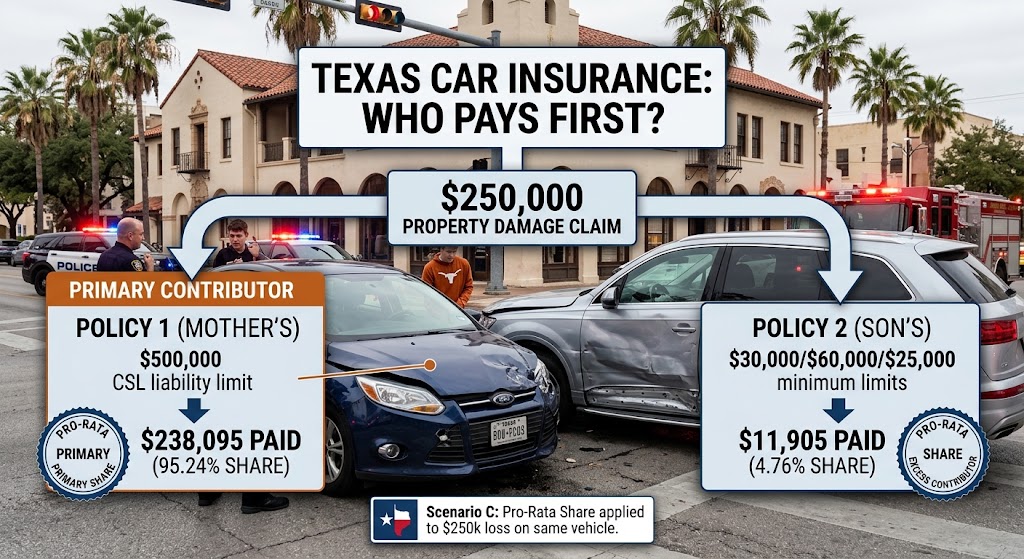
Sometimes, insurance situations get extremely messy and complicated. What if the mother kept the title, but the son managed to list the car as an “owned” vehicle on his new policy? If both insurance companies investigate the claim and accept their policies as primary, Texas law uses a special “pro-rata” rule.
Pro-rata means the two insurance companies will share the final bill. They split the total cost based on the size of their individual coverage limits. They do not split the bill exactly in half. Instead, the company with the bigger policy pays a much bigger piece of the pie.
Let us do the exact math for this scenario. The mother has a $500,000 limit for property damage. The son has a $25,000 limit for property damage. Together, they bring $525,000 in total available coverage to the table.
To find the mother’s share, we divide her $500,000 limit by the $525,000 total. This calculation shows she holds about 95% of the total coverage. Therefore, her car insurance company pays 95% of the $250,000 crash. Her company will write a check for exactly $238,095.
Next, we look at the son. He holds the remaining 5% of the total coverage. His company will pay 5% of the crash, or roughly $11,905. Both insurers coordinate their payments to ensure they cover the victim completely without ever double-paying for the same damage.
Why Double Car Insurance Coverage Hurts You
Reading about these various scenarios might make double coverage sound like a great safety net. However, you should never carry two primary policies on one car on purpose. Doing so hurts you in several major ways.
First, you waste your hard-earned money. You pay two expensive premiums every single month for overlapping coverage that you cannot fully use. You cannot legally collect double the money for a single claim. Insurance laws strictly forbid you from profiting from an auto accident. The principle of indemnity says you can only restore what you lost.
Second, double coverage creates an absolute nightmare during the claims process. When two companies discover each other, they almost always argue over who pays first. This intense arguing delays your payout. You might wait weeks or even months for the companies to settle their legal dispute.
Meanwhile, the accident victim might decide to sue you personally because they grow tired of waiting. You want your car insurance claims handled quickly and smoothly. Double coverage may lead to a slow and stressful experience.
How a Local Independent Car Insurance Agent Can Help
You can easily avoid these expensive mistakes by working closely with a trusted professional. You should never guess when it comes to policy contracts and liability limits. Instead, you need an experienced guide to protect you.
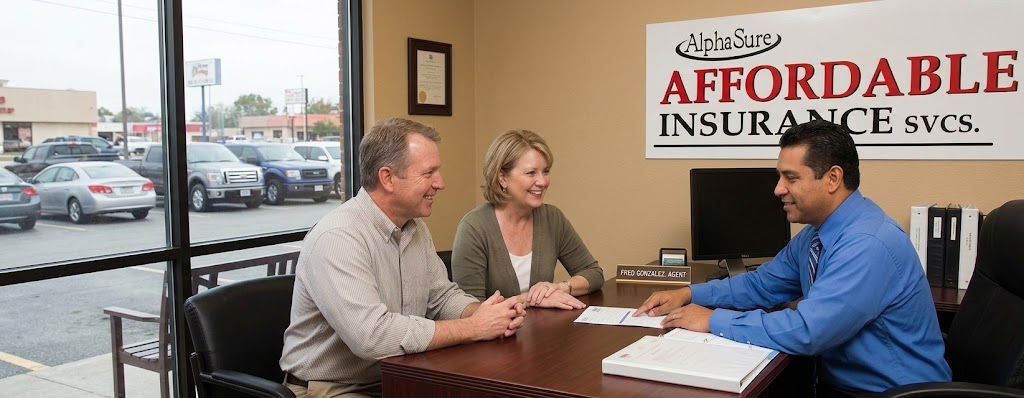
This is exactly where a local independent insurance agent like AlphaSure Affordable Insurance Services steps in to help you. Unlike captive agents who only sell one single brand, independent agents are contracted with several car insurance companies. Thus, they can help you by providing access to several companies with one auto insurance quote request.
If you need to change your car insurance because a child goes away to college, AlphaSure Affordable Insurance Services can quickly evaluate your entire situation. They will guide you so that you have the right coverage without any overlapping policies. Many times, they can handle the old cancellations, while binding a new policy. This way, there is no lapse in coverage.
Furthermore, the friendly agents at AlphaSure Affordable Insurance Services do not just handle auto insurance. They can also help you shop for home insurance. Bundling your car insurance and home insurance through one company unlocks massive discounts.
Most importantly, you gain incredible peace of mind knowing professionals are there to provide sound advice and guide you in the event of a claim.
Wrapping Up the Car Insurance Puzzle
Navigating the complex car insurance world often feels like wandering blindly through a maze. Rules about primary policies, secondary policies, and pro-rata shares confuse almost everyone. However, you do not have to figure out this complicated puzzle alone.
Always remember that insurance generally follows the vehicle in Texas. Whoever holds the actual title usually dictates which policy pays first. If you face a major life change, such as sending a kid to college or buying a new car, update your policies immediately. Always cancel your old coverage as soon as your new coverage begins.
Above all, reach out to local experts like AlphaSure Affordable Insurance Services. They will gladly help you shop the market. They will find you the best car insurance and home insurance rates while keeping your coverage well aligned. Protect your car, protect your wallet, and drive safely on the Texas roads!
Many drivers dread shopping for new car insurance. You might worry that getting too many quotes will damage your credit score. After all, lenders constantly warn us about the dangers of checking our credit too often. Therefore, it makes perfect sense to wonder if insurance companies follow the same strict rules.
If you want to find the best auto coverage, you need to compare rates. Fortunately, you can relax. Shopping for car insurance will not hurt your credit score.
In this comprehensive guide, we will explore exactly how insurance companies look at your financial history. We will explain the important differences between hard and soft credit pulls. Furthermore, we will show you how to navigate policies with your spouse. Finally, we will explain why partnering with a local independent insurance agent like AlphaSure Affordable Insurance Services is the smartest way to protect your family and your wallet.
Understanding Credit Inquiries
To understand why car insurance quotes are safe for your credit, you first need to know how credit inquiries work. Credit bureaus divide inquiries into two distinct categories: hard inquiries and soft inquiries.
What is a Hard Inquiry?
A hard inquiry happens when you apply for new debt. For example, if you apply for a credit card, a mortgage, or an auto loan, the bank pulls your official credit report. They want to see if you can repay the money you want to borrow.
Hard inquiries do affect your standard FICO credit score. Usually, a single hard pull will drop your score by fewer than five points. This penalty lasts for exactly 12 months. However, the record of the inquiry stays visible on your credit report for a full 24 months.
What is a Soft Inquiry?
On the other hand, a soft inquiry happens when someone checks your credit for a reason other than lending you money. When you check your own credit score on a free app, you trigger a soft inquiry. Employers and landlords also use soft pulls for background checks.
Most importantly, when you ask for a home or car insurance quote, the insurance company performs a soft inquiry. Soft inquiries are completely invisible to lenders. They never impact your FICO score. You can accumulate a dozen soft inquiries in a single week, and your credit score will stay exactly the same.
Rate Shopping: Auto Loans vs. Car Insurance
People often confuse the rules for buying a car with the rules for insuring a car. When you buy a vehicle, you usually need an auto loan. Getting that loan triggers a hard inquiry.
However, the major credit bureaus know that smart consumers shop around for the best interest rates. Therefore, FICO uses a special “de-duplication” window for auto loans. If you apply for a car loan at Wells Fargo, Chase, and Bank of America on the exact same day, FICO counts those three hard pulls as one single event. Depending on the credit model, this shopping window lasts between 14 and 45 days.
In contrast, car insurance shopping has no window and no limits. Because insurance companies only use soft pulls, you never have to worry about a time limit. You can shop for car insurance every single day of the year without ever losing a single credit point.
What is a Credit-Based Insurance Score?
You might wonder why auto insurers care about your credit history if they are not lending you money. They do not care about your ability to repay a loan. Instead, they use your data to create a “credit-based insurance score.”
A credit-based insurance score uses your financial data to predict your future driving behavior. Decades of statistical research show a strong link between credit management and accident risk. People who pay their bills on time and keep their credit card balances low tend to file fewer insurance claims. Conversely, drivers with poor credit file more claims.
Therefore, insurers use your credit-based insurance score to set your monthly premiums. If you have a high score, you usually get lower rates. If your credit score drops, your premiums will likely go up.
The Spouse Strategy in Car Insurance Quotes: Can You Swap Names?
Since credit plays a massive role in insurance pricing, married couples often try to game the system. If you have a great credit score, but your wife has a poor score, you might want to buy the policy using only your name. Is this allowed? Will it save you money?
The short answer is yes, you can put the policy in your name. However, it rarely works the way you hope. Let us look at the rules insurance companies use for married couples.
The Car Insurance Household Driver Rule
Insurance companies legally require you to list every licensed driver who lives in your home on your policy. This rule applies strongly to spouses. You cannot hide your spouse from the insurance company. Once you add your wife to the quote, the insurer’s computer system might check both of your driving records and credit-based insurance scores.
The Primary Insured Loophole
While both of you must appear on the policy, only one person acts as the “Named Insured.” The Named Insured is the primary policyholder. Many insurance algorithms give the primary policyholder’s credit score much more weight.
Therefore, you should always try a simple shopping strategy. Run two identical quotes. For the first quote, list yourself as the primary applicant and your wife as the secondary driver. Next, run a second quote with the roles reversed. Because every insurance carrier uses a slightly different math formula, swapping the primary applicant might save you some money.
Do Not Buy Separate Car Insurance Policies
Some couples get frustrated and try to buy two entirely separate auto policies. They think keeping the bad credit score away from the good credit score will fix the problem. You should never do this.
Married couples earn a massive “marriage discount” with almost every major insurance carrier. Furthermore, when you insure two or more vehicles on the same policy, you earn a multi-car discount. If you split your policies, you lose both of these major discounts. The loss of these discounts will cost you far more money than the penalty for a lower credit score.
The Car Insurance Named Driver Exclusion
If your spouse has truly terrible credit or a horrible driving record, you have one final option. Some states allow you to sign a “Named Driver Exclusion.” This legal document completely removes your spouse from your insurance policy.
However, this option carries a massive risk. If you exclude your spouse, they can never drive your car. If in an emergency your spouse has to drive and crashes, the insurance company will pay nothing. You will pay for all the damages out of your own pocket.
The Best Way to Shop: Use an Independent Car Insurance Agent
Shopping for car insurance takes time, energy, and patience. You will have to fill out endless online forms with each company you check. Thus, the car insurance shopping may be cumbersome or confusing.
Instead of fighting the system alone, you should hire a local expert. When you work with a local independent insurance agent like AlphaSure Affordable Insurance Services, you eliminate the stress of rate shopping entirely.
What is an Independent Car Insurance Agent?
Many insurance agents work directly for one single massive company. We call these “captive agents.” If you visit a State Farm agent, they can only sell you a State Farm policy. If their price is too high, they cannot help you.
In contrast, an independent agent like AlphaSure Affordable Insurance Services works for several insurance companies, not just one. Thus, you will have car insurance options to pick from.
How AlphaSure Saves You Time
When you call AlphaSure Affordable Insurance Services, you only explain your situation one time. You give them your vehicle details, your driver information, and your coverage goals.
Then, the agents at AlphaSure do all the heavy lifting. They plug your information into their advanced comparison systems and run quotes across multiple insurance companies simultaneously. Thus, they quickly identify which carrier offers the best price for your specific situation.
Expert Advice on Household Rules
Independent agents know the complex algorithms inside and out. If you and your spouse have vastly different credit scores, the experts at AlphaSure Affordable Insurance Services know exactly how to structure your application. They will test the quotes with different primary applicants to ensure you get the absolute lowest rate. They also ensure you receive every discount available to you, including marriage, multi-car, or safe driver discounts.
Help with Home Insurance Too
Car insurance is just the beginning. Independent agents also shop for your homeowner’s insurance. Insurers use your credit-based insurance score for home policies as well. AlphaSure Affordable Insurance Services can easily bundle your home and auto policies together. Bundling creates another discount, which should be considered when making the buying decision.
Improve Your Credit for Better Future Car Insurance Rates
While you rely on AlphaSure to find you the best current rate, you should also work on improving your credit score for the future. Every time your policy renews, the car insurance company might check your soft credit score again. If your score improves, your rates might drop.
Here are three simple steps you can take today to build a better credit profile:
First, pay every single bill on time. Payment history makes up the largest chunk of your FICO score. Set up automatic payments to ensure you never miss a due date.
Second, pay down your credit card balances. Credit utilization measures how much debt you carry compared to your total limits. Keep your balances low to see a rapid increase in your credit score.
Third, check your credit reports for errors. You can request free reports from the major bureaus. If you find a mistake, dispute it immediately. Removing an unfair collection account can boost your score overnight.
Conclusion
You never need to fear shopping for car insurance. Because insurance companies only use soft credit inquiries, checking your rates will never damage your credit score. You can safely compare as many carriers as you want.
If you want to maximize your savings without wasting your weekend, let the professionals do the work. A local independent insurance agent like AlphaSure Affordable Insurance Services has the tools, the knowledge, and the partnerships to find you the right car insurance policy. They will navigate the complex rules of credit scores and household drivers for you. Contact an independent agent today and discover how much money you can truly save.
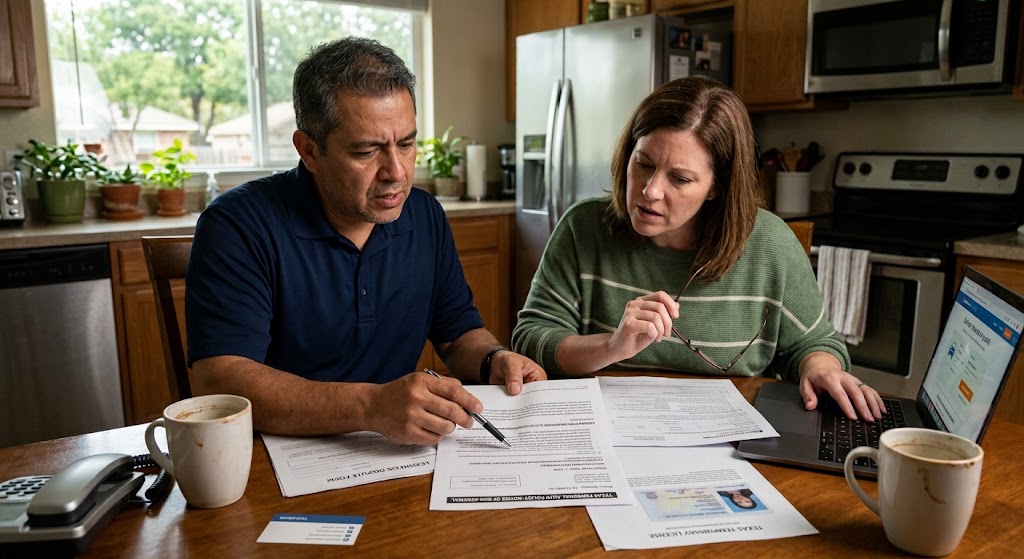
Opening your mail to find a non-renewal notice from your car insurance company feels incredibly frustrating. You pay your bills on time. You drive safely. However, your car insurance provider suddenly decides they no longer want your business. When this happens, you might feel confused and worried. What did you do wrong? First, you need to understand that a non-renewal is not a cancellation. A cancellation can happen, for example, when you stop paying your premium. In contrast, a non-renewal simply means the company will not offer you a new contract when your current policy expires. Therefore, you have time to fix the problem or find new coverage. In Texas, state law requires the insurance company to give you at least 60 days of notice. This gives you a two-month window to take action. Do not panic. Instead, take a deep breath and start planning your next steps. Finding great car insurance is still very possible if you know what to do.
Why Did Your Car Insurance Company Drop You?
Car insurance companies use complex formulas to decide who they want to insure. These formulas rely on underwriting guidelines. Underwriting is simply the process of measuring risk. If a company thinks you pose too much risk, they will send a non-renewal notice. Common reasons for non-renewal include having too many accidents, filing too many claims, or getting multiple speeding tickets. Sometimes, the company simply decides to stop doing business in your specific ZIP code. Recently, however, many drivers face non-renewals because of hidden household members. For example, if a company discovers an unlisted driver living at your address, they view this as a huge risk. They assume this person drives your vehicles. As a result, since the insurance company is not collecting premium for the unlisted driver, they may drop your coverage. This exact situation happens every day to honest, hardworking people. Knowing why the company dropped you is the first step toward solving the problem.
The Hidden Driver Trap
Let us look at a very common scenario. Imagine you have a grown son who moved out years ago. Recently, he took a driving test to get his official Texas driver license. When he filled out the paperwork, he used your home address. Suddenly, the state databases link his name to your house. Your car insurance company runs a routine background check. They see a newly licensed driver at your address. Because you did not list him on your car insurance policy, it goes against the car insurance company’s guidelines. Thus, they send you a non-renewal notice immediately. However, they usually send notices ahead of time. Insurance companies rely heavily on automated data sweeps. Consequently, you must prove that your son does not live with you. Until you prove this, other car insurance companies might also refuse to insure you.
How Public Databases Impact Your Car Insurance
Automated systems control much of the modern car insurance industry. Insurance providers rarely rely on human intuition anymore. Instead, they purchase huge amounts of data from third-party databases. The most famous database is LexisNexis. This company collects public records, credit histories, and claims data. They create a special file called a Comprehensive Loss Underwriting Exchange (C.L.U.E.) report. Your C.L.U.E. report tracks every auto and home insurance claim you file. Furthermore, companies like LexisNexis track your address history. They pull data from the Department of Public Safety (DPS) and the Department of Motor Vehicles. If someone registers a vehicle at your address, the database flags it. If someone uses your address on their license, the database flags it. Therefore, if a former household member fails to update their address, the system traps you. You may keep facing higher rates or non-renewals until you correct the underlying data.
First Step: Update State Records Immediately
To fix this mess, you must act quickly. First, tell the former household member to update their official state records. Texas law actually requires drivers to update their address within 30 days of moving. They can do this easily online. They should visit the official Texas Department of Public Safety website or use the Texas by Texas (TxT) digital portal. The process takes only a few minutes. At the end of the process, they can print a temporary paper receipt. This receipt shows their new, correct physical address. Next, they need to update their vehicle title and registration. Updating the registration online only changes where the state mails the sticker. To change the legal address on the vehicle title, they must fill out Form VTR-146. This is the Change of Address for Texas Motor Vehicle form. They must mail this form to the Texas D.M.V. in Austin. Taking these steps stops the bad data at the source.
Second Step: Clear Your Name with LexisNexis
Updating the state records helps the future, but it does not fix the past. Your car insurance company already pulled a bad LexisNexis report. Therefore, you must dispute the inaccurate information directly with LexisNexis. Under the Fair Credit Reporting Act, you have the right to challenge wrong information on your consumer file. First, you should go to the LexisNexis Consumer Center website. You can submit a formal dispute online or call their toll-free number. Tell them clearly that the specific individual no longer resides at your address. Provide the person’s new address if you know it. LexisNexis has 30 days to investigate your claim. Once they verify the facts, they will remove the false household information from your file. This step is crucial. If you skip this step, the bad data will follow you. Every time you shop for car insurance, the new company will see the same wrong information.
Third Step: Fight the Car Insurance Non-Renewal
Do not wait 30 days for LexisNexis to finish their investigation. You only have 60 days before your car insurance expires. You need to contact your current insurance company’s underwriting department right now. First, gather hard evidence. Get a copy of the temporary DPS receipt showing the former member’s new address. Next, get a copy of their current lease agreement or a recent utility bill. Finally, show proof that you filed a formal dispute with LexisNexis. Send all these documents to your insurance underwriter. Politely but firmly demand that they rescind the non-renewal. You must prove to them that they made a mistake. Often, human underwriters will look at your proof and override the automated system. They should reinstate your car insurance policy. However, sometimes companies refuse to listen. If they stubbornly ignore your proof, you must move on. You do not want to do business with a company that ignores hard facts anyway.
Why You Need a Local Independent Car Insurance Agent
When you need to find new car insurance, you have choices. You could spend hours calling 1-800 numbers. You could type your private information into random websites. However, the smartest choice is to use a local independent insurance agent. For example, AlphaSure Affordable Insurance Services can help you navigate this exact problem. Independent agents differ from captive agents. A captive agent works for only one company. If that company rejects you, the captive agent cannot help you anymore. In contrast, an independent agent like AlphaSure Affordable Insurance Services represents dozens of different insurance companies. They do the legwork for you. Furthermore, independent agents know the local Texas market. They understand how underwriting works. They know which companies accept drivers with complex background issues. They shop your profile across multiple top-rated carriers to find the best possible deal.
The Benefits of Bundling Home and Car Insurance
When you work with a local agent like AlphaSure Affordable Insurance Services, you should ask them to look at your home insurance too. Combining your car insurance and home insurance with the same company creates a bundle. Bundling offers massive benefits. First, it triggers significant discounts. Insurance companies love customers who buy multiple policies. Second, bundling simplifies your life. You only have to deal with one company, one bill, and one renewal date. Finally, having a bundled package makes you a more valuable client. Car insurance companies hesitate to non-renew a customer who brings them so much business. If a data error occurs again, they might give you the benefit of the doubt because you hold multiple policies with them. Always ask your independent agent to quote a bundled package. You might save hundreds of dollars a year.
Taking Fast and Decisive Action
Time is your biggest enemy when you face a non-renewal. A lapse in your car insurance creates a disaster. If your policy expires, even for one single day, you may face massive penalties. New insurance companies look closely at your insurance history. If they see a lapse, they might label you as a high-risk driver. They will charge you significantly higher rates for the next six months to a year. Therefore, you must secure replacement coverage before your current policy ends. Keep a close eye on the exact cancellation date. Work closely with your independent agent to get a new policy bound and active beforehand. You can easily transition from your old policy to your new one without missing a beat. Remember, a non-renewal feels personal, but it is just business. Stay calm, gather your facts, and take control of the situation today.
Understanding Texas Minimum Coverage Laws
While you shop for a new policy, you must remember the Texas legal requirements. Texas law demands that every driver carry basic liability car insurance. This pays for the damage you cause to other people in a car crash. The state requires minimum limits of 30/60/25. This means $30,000 for bodily injury for each person you may hurt, $60,000 for total bodily injury per accident, and $25,000 for the property damage of others. However, carrying only the minimum limits puts you at great financial risk. If you total a new luxury truck, $25,000 will not cover the cost. The other driver can sue you for the remaining balance. Therefore, you should always ask your independent agent at AlphaSure Affordable Insurance Services to quote higher liability limits. Protecting your financial future costs only a few dollars more each month. Higher limits give you peace of mind when you drive on busy Texas highways.
Frequently Asked Questions About Car Insurance Non-Renewals
Many drivers ask similar questions when facing a car insurance non-renewal. First, people ask if a non-renewal ruins their credit. The answer is no. A non-renewal does not affect your credit score in any way. Next, drivers ask if they have to report the non-renewal to the new company. Usually, you do not need to volunteer this information unless the new application specifically asks. Finally, people wonder if they should file a complaint. If you believe the insurance company broke the law or acted in bad faith, you absolutely should complain. You can file a formal consumer complaint with the Texas Department of Insurance. They regulate the industry and investigate unfair practices. While a complaint might not get your policy back, it holds the company accountable for their actions. Always stand up for your rights as a consumer.
The Role of Credit in Auto Insurance
In addition to your driving record, your credit history plays a massive role in your car insurance rates. In Texas, car insurance companies legally use your credit-based insurance score to determine your premium. They argue that drivers with excellent credit file fewer claims. Therefore, improving your credit score can lower your monthly bill. Pay your credit cards on time and keep your balances low. Do not open unnecessary credit accounts. When you combine a clean driving record with a high credit score, you unlock the cheapest possible rates. Taking care of your overall financial health directly benefits your auto insurance costs.
Conclusion: Turn a Problem into an Opportunity
Getting a car insurance non-renewal notice initially feels like a huge setback. It creates stress and forces you to do extra paperwork. However, you should view this event as a powerful opportunity. Many drivers stay with the same car insurance company for years. They rarely check to see if they are overpaying. Because you must shop for a new policy now, you might actually save money. By partnering with a local independent agent like AlphaSure Affordable Insurance Services, you unlock access to a huge insurance market. You fix your public records, clear your name, and secure a much better policy. Ultimately, you regain control of your financial life. Take action today, update those records, and let a professional agent find you the perfect car insurance fit.
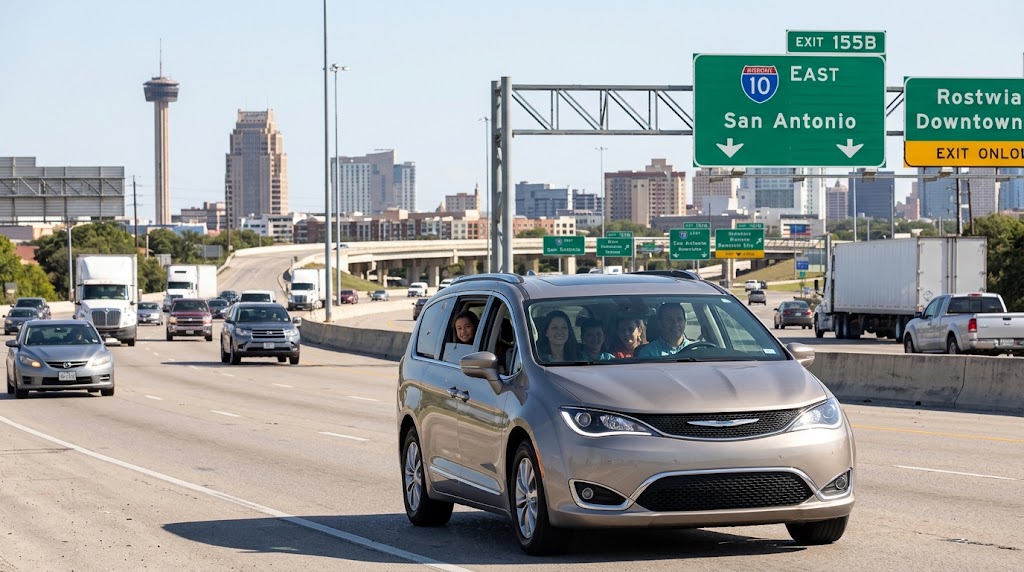
Road trips create some of the best memories. Recently, a car insurance customer of mine planned the ultimate baseball getaway. He drove all the way from San Antonio, Texas, up north to Detroit, Michigan. He wanted to visit his adult son and catch a great baseball game together. They spent a fun day exploring Detroit and cheering at the ballpark. After that, they decided to keep the adventure going. They drove across the border into Canada to watch the Toronto Blue Jays play.
This spontaneous road trip sounded amazing. However, it brought up an important question before they crossed the border. The customer called me to ask about his auto policy. He wanted to know exactly how his Progressive car insurance policy works while driving in Canada. He did not want to face any legal trouble in a different country. Taking the time to ask this question saved him a lot of stress.
Crossing the Border: Do You Have Car Insurance Coverage?
Many people assume their auto policy stays the same no matter where they drive. For the most part, a standard US auto policy extends your coverage into Canada. Therefore, you do not usually need to buy a separate policy just for a short weekend trip. However, every insurance company handles international travel a little differently. Plus, Canadian law may have other requirements that need to be addressed.
Because the customer planned to drive his own vehicle into a foreign country, he made the smart choice to call me first. He asked a great question that many travelers forget to ask. We needed to make sure he had the right paperwork before he reached the border crossing. Without the proper documents, Canadian border officials may fine you or turn you around. Fortunately, we quickly sorted out the details. We reviewed his policy documents to ensure he had adequate protection for the long drive.
Adding a Driver to Your Car Insurance
When we reviewed his Progressive car insurance policy, we found a minor detail we needed to fix. The customer planned to share the driving duties with his son. Naturally, they wanted to take turns behind the wheel during the long drive from Detroit to Toronto. Sharing the driving load keeps everyone awake and safe on the highway.
Even though the son no longer lives with his father, Progressive required us to add him as a listed driver on the policy. This was done so that the the Canadian car insurance ID card will list the son as a driver. We added his son to the policy right away. This simple update took only a few minutes, but it provided peace of mind.
The Canadian Non-Resident Liability Card
Next, we had to get the correct proof of insurance. Canada requires specific documentation from foreign drivers. You cannot just show your standard US digital insurance card on your cell phone. Instead, Progressive needed to provide a special document.
This physical document is called a Canada “non-resident” inter-province motor vehicle liability insurance card. It proves to the Canadian government that you carry the required minimum liability limits to drive on their roads. Furthermore, you need this card to cover all drivers listed on the policy. I made a quick phone call to Progressive on behalf of my client. I explained the situation to the representative. Within a few minutes, the representative generated the special Canadian liability card. Progressive sent it straight to the customer’s email inbox. He printed the card out at his hotel, and they were completely ready to go.
Preparing Your Vehicle for an International Trip
Aside from updating your auto policy, you must prepare your vehicle before you drive into a different country. A long road trip puts a lot of stress on your car engine and tires. Therefore, I always tell my clients to get a full mechanical inspection before they leave town.
First, check your tire pressure and tire tread. You need good traction if you encounter rain or bad weather near the Great Lakes. Next, top off all your essential fluids, including your motor oil, coolant, and windshield washer fluid. Furthermore, make sure your windshield wipers work perfectly. My customer drove a reliable truck, but he still checked everything before leaving Texas. Taking these simple steps drastically reduces your chances of a breakdown. When you combine a well-maintained vehicle with solid car insurance coverage, you set yourself up for a highly successful road trip.
Car Insurance Option: Roadside Assistance and Trip Interruption Benefits
Before they hit the open road, we also talked about emergencies. Driving long distances always carries some risk. A flat tire, a dead battery, or a broken engine can quickly ruin a fun vacation. Because of this, I reminded him about the Roadside Assistance coverage on his Progressive car insurance policy. This coverage pays for towing, jump-starts, flat tire changes, and lockout services.
Even better, Progressive offers a fantastic feature called Trip Interruption coverage. If your car breaks down more than one hundred miles from your home, Trip Interruption helps pay for surprise expenses. For example, up to a certain policy limit, it covers hotel rooms, meals, and emergency transportation while a mechanic fixes your car. Since they were traveling hundreds of miles away from San Antonio, this coverage gave them total peace of mind. If a breakdown happened in Canada, they would have benefits that help pay for extra hotel nights.
Enjoying the Game with Total Peace of Mind
Because he called ahead, my customer and his son enjoyed a completely stress-free trip. They crossed the Canadian border without any problems. They showed their Canadian car insurance liability card to the border agents and drove straight to Toronto.
Later, he told me that watching the Blue Jays play in their home stadium was a fantastic experience. They ate great stadium food, watched amazing baseball, and bonded on the open road. More importantly, they never had to worry about what might happen if they had a fender bender or if their car broke down. They knew their auto policy protected them every single step of the way. This real-life story shows exactly why you should always double-check your car insurance policy before a big road trip. A ten-minute phone call can save you thousands of dollars and hours of frustration. Always prepare before you travel.
Why You Need a Local Independent Car Insurance Agent
Dealing with giant insurance companies can feel confusing. You might wait on hold for a long time if you call a 1-800 number. You might talk to a different person every single time you call. This is exactly why you need a local independent car insurance agent.
When you work with a local agent, you get direct, personalized service. As an independent agency, AlphaSure Affordable Insurance Services helps drivers in San Antonio and Laredo find the best possible coverage. We do not work for just one company. Instead, we shop around to compare rates from several different carriers for you. Whether you need cheap car insurance or reliable home insurance, we do all the hard work so you do not have to. When life throws you a curve ball, or when you just want to drive to a baseball game in Canada, we are here to help. Contact AlphaSure Affordable Insurance Services today to review your current policy and get a free quote!
Have you ever heard the saying that a totaled car equals a paid-off loan? Many drivers believe this common myth. They think that if they crash their vehicle, their car insurance will step in and completely wipe out their remaining loan balance. However, this is rarely true. Let us explore the reality of what happens when you total your car and how you can protect your wallet.
Common Car Insurance Myth
If a vehicle is totaled, the insurance payout will completely wipe out the remaining auto loan or lease balance. People often think standard car insurance acts as a magical eraser for their car debt.
The Car Insurance Reality
Standard car insurance policies do not care about your loan balance. Instead, they pay the Actual Cash Value (ACV) of your vehicle at the time of the loss. Unfortunately, the ACV aggressively factors in depreciation. A new car loses a huge chunk of its value the second you drive it off the dealership lot. Therefore, your insurance company will only pay what the car is worth today, not what you originally paid for it.
The Danger of Being Underwater
Because vehicles lose value so quickly, you might owe more on your loan than the car is actually worth. Financial experts call this being “underwater” on a loan. If you total your car while you are underwater, your standard car insurance, with comprehensive and collision, will not cover the full loan amount. As a result, you have to cover the difference out of your own pocket. Paying thousands of dollars for a car you can no longer drive is a terrible financial burden.
The Solution: Gap Insurance added to the Policy
How can you avoid this expensive trap? You need to specifically carry Gap insurance. Gap coverage pays the difference between your car’s actual cash value and the remaining balance on your auto loan. If you have this specific coverage, you will not have to empty your savings account to pay off a wrecked vehicle. Gap insurance does have restrictions so be sure to talk to your agent about that.
Get Expert Help Today
Finding the right car insurance coverage can feel confusing. Fortunately, you do not have to figure it out alone. You can reach out to a local independent insurance agent like AlphaSure Affordable Insurance Services to help in shopping for car or home insurance. The experts at AlphaSure will review your current policy and help you find a policy that won’t break the bank.
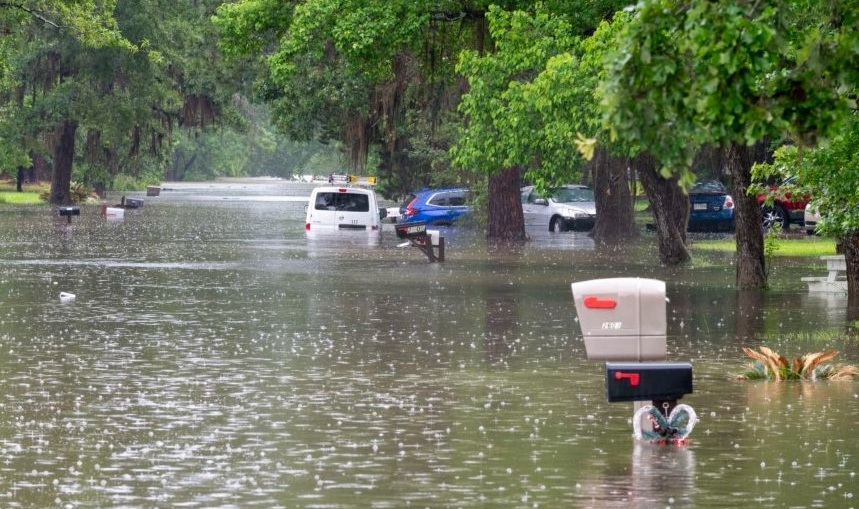
Texas weather changes fast. One minute the sun shines, and the next minute, a flash flood warning flashes on your screen. When severe weather heads your way, you might want to check your car insurance. However, waiting until a storm gets close creates a huge problem. This is because car insurance companies usually put a “binding moratorium” in place. As a result of this moratorium, you could face massive repair bills.
What is a Binding Moratorium in Home and Car Insurance?
First, let us explain what a binding moratorium actually means. A moratorium is simply a temporary freeze on new policies. When the National Weather Service issues a severe storm or flood warning, insurance companies stop selling new car insurance policies in that specific area. In addition, they will not let you change your current policy. For example, you cannot add comprehensive coverage or lower your deductible until the storm completely passes and your vehicle is undamaged.
Why Do Insurance Companies Use These Rules?
You might wonder why insurers use these strict rules. Basically, car insurance exists to protect you from future, unexpected problems. If people only bought coverage when a flood was guaranteed to hit, the insurance companies would stand to suffer huge claims. Therefore, they use moratoriums to keep their business stable.
Why You Need Coverage Early
As a result of these rules, you must set up your insurance policy before the dark clouds roll in. If rising water damages your car, you need comprehensive coverage to pay for the repairs. Sadly, if you try to buy this coverage during a moratorium, the company will say no. Thus, if your car is damaged in the flood, you have to pay the entire repair bill yourself.
How a Local Home and Car Insurance Agent Can Help
To avoid this stressful situation, you should plan ahead. A local independent insurance agent like AlphaSure Affordable Insurance Services can help you shop for the best car or home insurance. We understand Texas weather risks, and we can help find a policy that fits your budget.
Getting into a minor fender bender is always stressful. However, knowing exactly what to do next makes a huge difference. If you handle the scene correctly, you will have a much easier time filing a car insurance claim. Follow these simple steps to protect yourself and your vehicle.
Move Your Vehicle and Call the Police
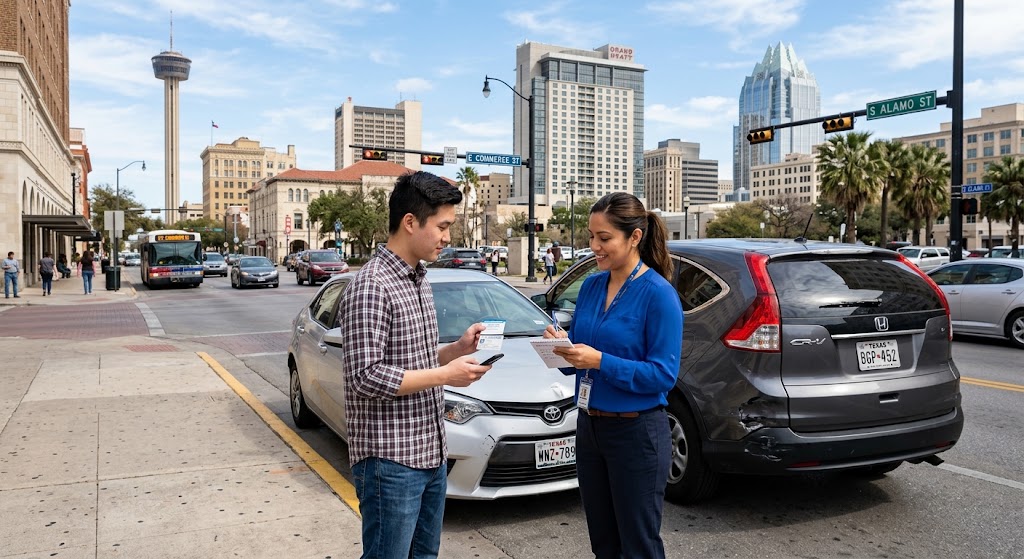
First, check everyone for injuries. If the cars can still drive safely, you must move them out of the traffic lanes. This keeps everyone safe and keeps traffic moving. Next, assess the other driver. If the other person is uncooperative or angry, call the police immediately. Always ask to file an official police report because it provides a reliable record of the crash.
Swap Details and Find Witnesses for a Car Insurance Claim
Always exchange contact information with the other driver. Get their full name, phone number, and current car insurance details. Additionally, look around for anyone who saw the crash happen. Ask for their phone numbers, too. Witnesses can prove exactly what happened if the other driver changes their story later on.
Document the Accident Scene
Before you leave the area, pull out your smartphone. Take clear pictures of the damage on both cars. Also, snap a quick photo of the other driver’s license plate and insurance card. Furthermore, if you use a dash cam in your vehicle, save the video file right away. Video proof is the absolute best way to speed up your car insurance claim.
Talk to the Car Insurance Company
If the other driver is clearly at fault, ask them to file a claim with their company right then. Insist that both of you give a recorded statement to the insurance adjuster while the details are fresh. This locks in their story.
However, you must be careful with your own words. Stick only to the facts. Never admit fault, and do not tell the adjuster you are completely uninjured. Adrenaline hides physical pain, and soft tissue injuries often show up a day or two later.
When to Use Your Own Car Insurance
Sometimes, you run into trouble with the other driver’s company. For instance, the damages might exceed your collision deductible, making it smarter to file the claim with your own policy. Other times, you might discover the at-fault driver let their policy lapse. If their company denies the claim, your uninsured motorist coverage will step in to help pay for the damage.
Find the Right Coverage with a Local Agent
Finally, make sure you have the right protection long before an accident happens. Shopping for car insurance or home insurance is simple when you use a local independent insurance agent. The dedicated team at AlphaSure Affordable Insurance Services can help you compare different options. We work hard to find you the best rates and the exact coverage you need. Reach out to AlphaSure Affordable Insurance Services today to review your current policy and drive with true peace of mind.